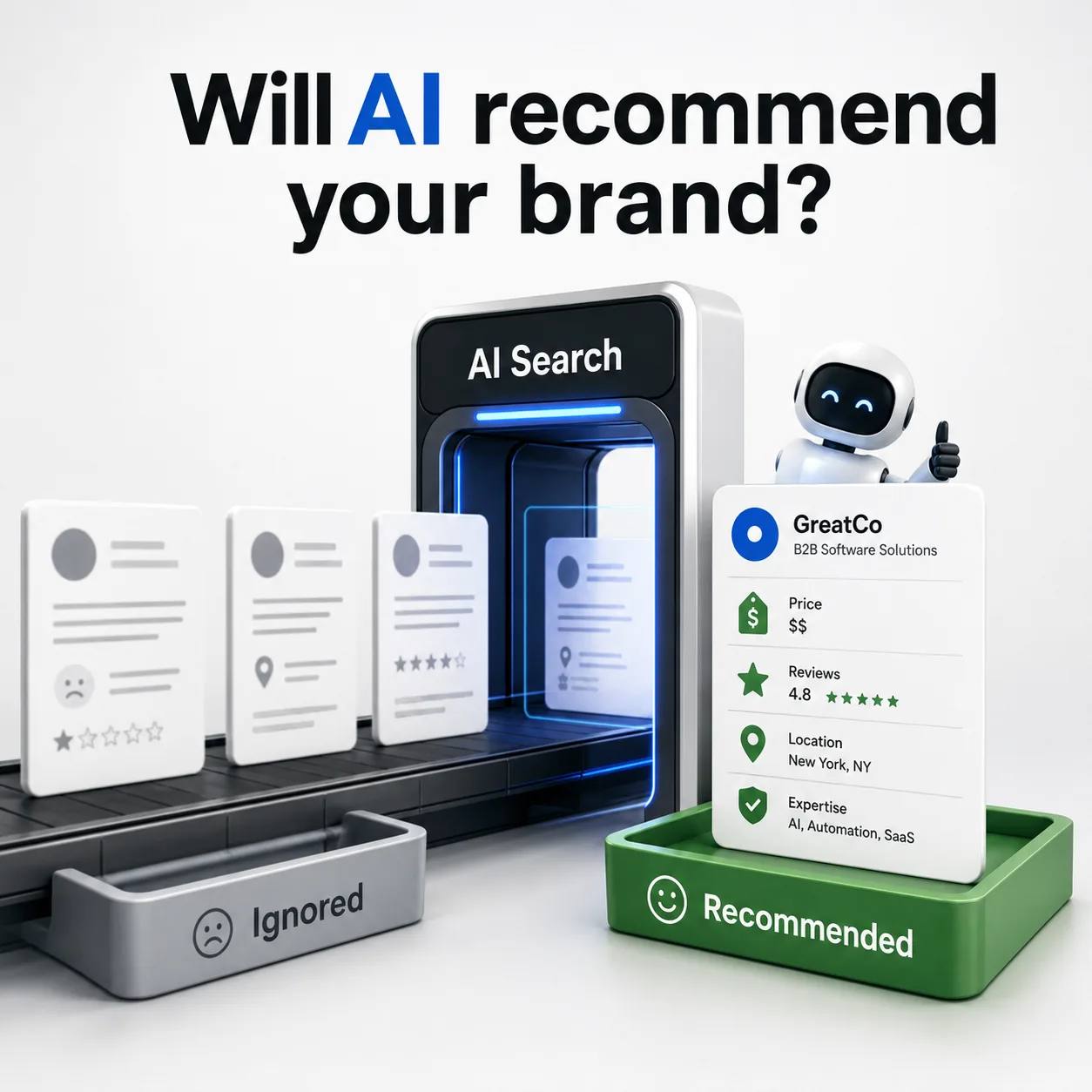

Search is still here, but the path to discovery is changing. The old game was simple: win a click from the results page, then persuade the person after they land. The newer game is different. More often now, an AI system filters the options before the customer even opens a site.
That does not mean every query ends with one answer or that classic search is gone. It does mean you can no longer assume a strong ranking is enough. When someone asks an assistant for the best option, a comparison or a recommendation, the assistant may answer directly and cite only a few sources. If your business is missing from that answer, you are invisible at the exact moment interest shows up.
The new middleman is a decision layer
Classic search mostly sent people to pages. AI search is increasingly reading the question, gathering material and composing an answer. ChatGPT Search, for example, can reformulate a prompt into web queries and then show inline citations or a sources panel in the response. OpenAI's documentation explains that flow from the user side.
The important point is not that a model replaces every search result. The important point is that a model now sits between the customer and the open web and decides what is worth pulling forward. A slogan like "market leader" gives it very little to work with. A precise specification, a clear return policy, a compatibility note or a verified delivery window is much easier to compare and trust.
In an answer-first interface, the business that gets mentioned is often the one that is easiest to verify, not the one that shouts the loudest.
Your website is becoming a data source
This is a useful mindset shift for anyone building or marketing a site. A website is no longer just a brochure or conversion page. It is also a public data source that search and AI systems need to retrieve, understand and cite.
Different AI products use different retrieval and ranking pipelines. Some look a lot like RAG, some do not. The safer move is to focus on what these systems consistently need from a page:
| What the system needs | What the page should provide |
|---|---|
| A direct answer | A section that answers one question clearly without relying on surrounding fluff |
| Evidence to compare | Specific facts: price, materials, limits, delivery, availability and policy details |
| A trustworthy source | Consistent information across the page, schema, checkout, profiles and third-party listings |
| Something it can access | Crawlable pages, useful text, internal links and a technically healthy site |
That is why self-contained passages matter so much. A crawler may surface one section, not your whole page. Write headings that match real questions, then make the paragraph below each heading complete enough to quote on its own.
What has not changed: SEO is still the base layer
This is where the "SEO is dead" take falls apart. Traditional SEO is not becoming less important. It is becoming infrastructure. Google says the same best practices still apply for AI Overviews and AI Mode: useful text needs to be available to crawlers, structured data needs to match visible content and the page still has to be eligible for Google Search in the first place. There is no magic AI-only markup that guarantees inclusion. See Google's guidance for AI features and websites.
That makes technical hygiene non-negotiable. If a page cannot be crawled, indexed, rendered, linked properly or trusted as a source, an AI system has less chance of surfacing it. The same goes for conflicting business data. If a product price differs between the page and the cart, or a return policy disagrees with a marketplace listing, the recommendation layer sees uncertainty where it needs confidence.
Five practical steps for the AI answer era
1. Replace claims with evidence
Audit major landing pages for vague copy. Replace "best quality" with material details, test results, warranty terms, supported use cases or independently verifiable outcomes. There is no universal visibility uplift from doing this. The simpler truth is that evidence is easier to retrieve, compare and cite than slogans.
2. Design for extractable passages
Structure pages around real buyer questions. Give each section a descriptive heading, explain the subject in the first sentence and then add the key limitation or proof. A product page should say who it is for and who it is not for. A B2B service page should state scope, delivery model, implementation time and exclusions.
3. Treat honest negatives as product data
Sometimes the most useful sentence on a page is a limitation. "Not suitable for wide feet" is less flashy than a universal claim, but it is more helpful. It helps both people and assistants rule out a bad fit and makes the positive recommendation more believable for the right buyer.
4. Earn third-party evidence
Your site explains what you say about yourself. Reviews, expert comparisons, partner pages, industry coverage and reputable "best of" lists give assistants outside material to cross-check. This is not a shortcut for weak content. It is the external proof that makes a recommendation easier to defend.
5. Run the site like a verified database
Create one source of truth for high-intent facts such as pricing, stock status, service area, support windows, compatibility, delivery and returns. Then make sure those same facts flow into the page, schema, checkout, feeds and business profiles.
What I would ship in the next 30 days
The point is not to bolt on a new pile of "AI hacks." The point is to make existing business evidence easier to access, compare and trust.
| Week | Ship | Proof it is done |
|---|---|---|
| 1 | Baseline and technical access | Search Console and Bing Webmaster Tools are verified; crawl and indexing issues are fixed; important pages are available as text; robots and CDN rules allow relevant search crawlers. |
| 2 | Evidence-first commercial pages | The ten highest-intent pages answer real buyer questions and include specifications, constraints, pricing, delivery, returns and comparison tables where useful. |
| 3 | Consistent entity data | Product and service facts match across landing pages, structured data, checkout, feeds, Google Business Profile and trusted third-party listings. |
| 4 | Measurement and proof | Branded and non-branded search, referral traffic, conversions and cited mentions are tracked; one expert guide or comparison has been published for others to reference. |
Start with the pages closest to revenue, not with a broad content sprint. One clear product page with verified facts is usually worth more than ten generic articles about AI search.
The real goal is justified recommendation
The shift toward AI answers is not a reason to abandon normal search or chase a new acronym for its own sake. It is a reason to make the business legible.
The website that wins will not always be the one with the most content or the loudest copy. It will be the one that makes a recommendation easy to justify with accurate, accessible and consistent evidence.
Build pages a customer can trust without a sales call. Build those same pages so a search engine can index them and an AI system can cite them. The click is no longer the only gate to discovery, but it still matters once you have earned the recommendation.