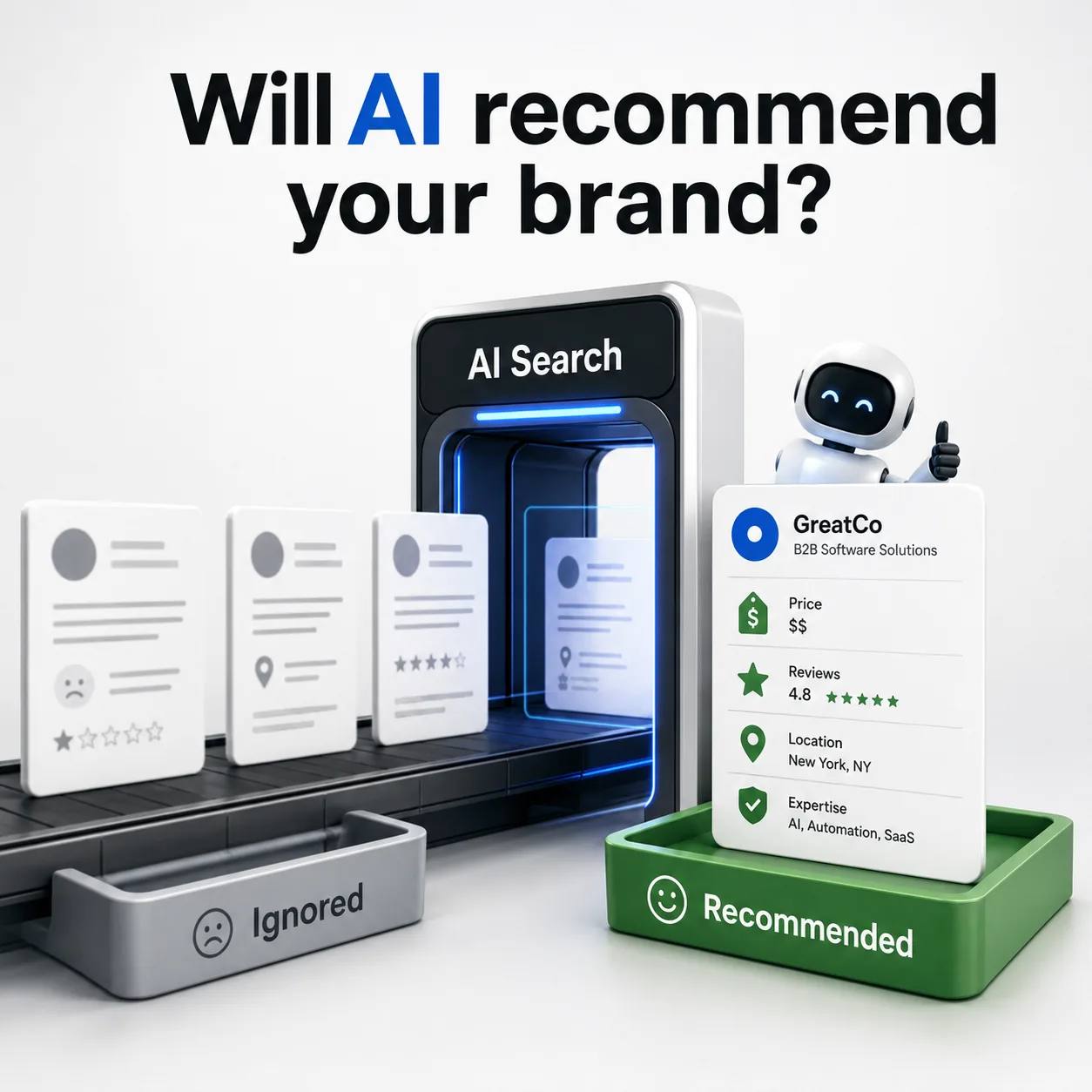
Picture a buyer asking ChatGPT, Perplexity or Google Search for the best company in your category. Your team may have a solid product, happy clients and decent SEO, but the answer still mentions someone else. That usually does not mean your business is bad. It often means the system could not understand you fast enough or trust you enough to name you.
That is the practical side of Generative Engine Optimization, or GEO. In classic search, the fight was mostly about rankings and clicks. In AI-assisted search, the harder question is this: can the system justify mentioning your brand at all? If it cannot pull clear facts, compare you with alternatives or verify your claims elsewhere, you become easy to skip.
Visibility is changing because the interface changed
Websites still matter. What changed is the moment when the decision starts.
People increasingly see an answer before they see a list of links. Google's own documentation for AI features makes this pretty clear: your pages still need to be crawlable, indexable, technically sound and genuinely useful. AI visibility does not replace SEO. It depends on it.
The difference is that weak visibility hurts more now. In old search, you could still survive halfway down the page and hope the user kept scrolling. In an answer-first interface, a lot of users never get that far. Ahrefs' 2026 update estimates that AI Overviews cut the organic CTR of position-one pages by around 58% on affected queries. The exact number will vary, but the direction is obvious: more intent gets resolved before the click.
AI is doing a kind of digital face control
That phrase is blunt, but it helps. AI search is not only retrieving information. It is filtering who looks credible enough to mention.
It is effectively asking:
- Does this page answer the question directly?
- Are the claims specific enough to compare?
- Do trusted third-party sources support the same facts?
- Does the company look consistent across pages and profiles?
- Is there enough evidence here to cite safely?
If the answer is no, you usually do not get a dramatic penalty. You just disappear from the answer. In practice, that can be worse than a ranking drop because the buyer never even knows you were an option.
Facts matter more than adjectives
This is where a lot of marketing copy stops helping.
Phrases like "market-leading," "premium service" or "individual approach" may still sound nice to a human after the click, but they give an AI system almost nothing to work with before the click. It has much more use for:
- clear pricing logic
- delivery windows
- supported regions
- service limits
- licensing or certification details
- documented implementation steps
- return, refund or support policies
That is one of the strongest takeaways from the original GEO paper. The authors showed that more extractable, evidence-rich content can improve visibility in generative answers, with some methods producing gains of up to 40% in their benchmark. The practical lesson is not that every business gets the same uplift. It is that structure and evidence change whether a model can reuse your content.
Your opening section needs to earn its place
Many pages waste the most valuable part of the screen on vague brand throat-clearing.
If a page is meant to win a commercial query, the opening section should quickly explain:
- what you offer
- who it is for
- where it applies
- what the key limitation or differentiator is
- what proof supports the claim
This is not about some magical word-count trick. It is about extractability. Retrieval systems often surface passages, not entire pages. If the useful answer only shows up after three paragraphs of generic copy, you are making the model do too much work.
Earned media matters because AI does not want to trust you alone
Your website is necessary. It is just not enough on its own.
Recent GEO research comparing AI search with traditional web search found that AI answers lean heavily on earned media: third-party coverage, reviews, reference pages and other sources you do not control directly. That is logical. If a system has to justify a recommendation, outside confirmation is safer than self-description.
This is where a lot of companies get the strategy backward. They polish landing pages, but ignore the evidence layer around the brand. In practice, AI visibility often improves when you have:
- credible industry mentions
- detailed review profiles
- comparison articles
- partner pages
- expert commentary
- communities where real users discuss concrete pros and cons
This is not PR for vanity's sake. It is independent verification.
Consistency is part of trust
An AI system does not experience your company as one clean homepage. It sees fragments: a pricing page, a review, a service page, a profile, a comparison post, a listing.
When those fragments disagree, trust drops. If your timeline says one thing on the site, another in a sales deck and a third in a marketplace profile, the system has less confidence recommending you. The same goes for pricing, geography, support windows and capabilities.
That is why GEO is not just a content exercise. It is also a data-governance exercise. The cleaner and more consistent your business facts are across the public web, the easier they are to cite.
What I would fix first
If a company wanted to improve AI-search visibility quickly, I would start with four moves.
1. Rebuild high-intent pages around direct answers
Take the pages closest to revenue and rewrite the first screen so the offer is explained plainly, with facts instead of slogans.
2. Add comparison-ready evidence
Publish the details that help both a machine and a buyer compare options: scope, exclusions, pricing logic, delivery model, proof points and limitations.
3. Audit third-party visibility
List the places where the brand appears outside your own site, then check whether those mentions are current, detailed and consistent.
4. Treat inconsistencies as ranking risk
Fix contradictions across site copy, structured data, profiles and public references. Messy facts are not just a branding issue anymore.
GEO is not a replacement for SEO
This is still the part many teams get wrong. GEO is not a clever new shortcut that replaces search fundamentals. It is new pressure on the same foundation.
If your site is hard to crawl, hard to understand, weak on evidence or disconnected from the web's wider trust graph, AI systems have less reason to surface you. The brands that stay visible will not always be the loudest ones. They will be the easiest to verify, the easiest to compare and the safest to cite.
That is what digital face control really means in 2026. More decisions are happening before the click. Your job is to make your business one of the options an AI can mention without hesitation.