The interesting question is no longer whether teams use AI. Most already do, or they are about to. The real question is whether that usage turns into reliable output or just creates a larger pile of review, rework and token spend.
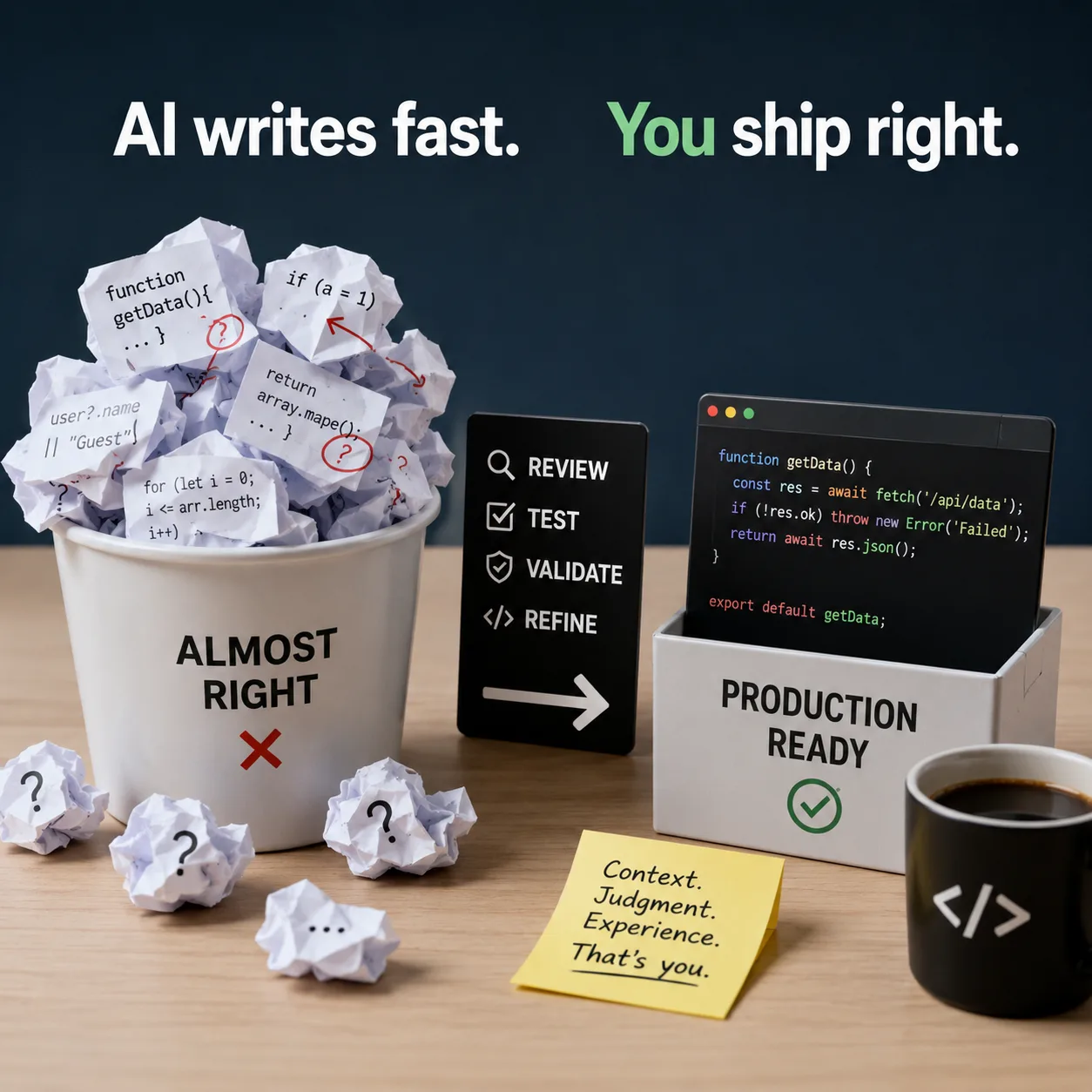
That difference matters because adoption and productivity are not the same thing. Stack Overflow's 2025 developer survey says 84% of respondents are using or planning to use AI in development. The same survey also shows the pain point clearly: 66% cited "almost right, but not quite" answers as a major frustration. That, more than anything, is the management problem.
The productivity story is real, but uneven
If we want to be honest about AI agents in engineering, we have to hold two ideas at once.
First, the upside is real. McKinsey reported strong gains on routine work: documentation in roughly half the time, new code in nearly half the time and refactoring in close to two-thirds the time.
Second, those gains do not carry across every kind of task. The same McKinsey study found that time savings fell below 10% on work developers considered highly complex. METR's early 2025 open-source study was even more sobering: experienced developers took 19% longer with AI tools. A later 2026 METR update found only weak evidence of improvement for a returning subset, with wide confidence intervals and clear warnings about selection effects.
The practical takeaway is simple. AI agents are not a universal productivity multiplier. They are a task-shaped tool. The value depends on the work itself, the cleanliness of the codebase, the process around the task and the person steering the agent.
"Almost right" code is expensive code
Teams rarely lose money because an agent writes something obviously broken. They lose money because the output looks believable enough to survive a lazy first pass.
That is why "almost right" is such an expensive outcome:
- It passes the quick visual check.
- It often compiles and may even satisfy the happy path.
- It hides problems in edge cases, state transitions, type assumptions, security boundaries or UI behavior.
- It creates review debt, because another engineer now has to prove where it is wrong instead of writing the right solution directly.
Stack Overflow's 2025 survey says only 33% of respondents trust AI output, while 46% actively distrust it. That skepticism is healthy. If your team treats agent output like finished code instead of a draft that has to earn trust, the savings disappear later in review and incident cleanup.
Where agents are genuinely useful
The most reliable wins usually show up when the task is narrow, repetitive and easy to verify.
| Good fit for agents | Why it works |
|---|---|
| Boilerplate and scaffolding | The shape is predictable and review is quick |
| Unit tests and fixtures | The scope is narrow and expected behavior is clear |
| Documentation and summaries | The agent is good at compressing existing information |
| Mechanical refactors | The intent is defined before execution starts |
| Codebase search and investigation | Agents can scan and summarize faster than a human starting from zero |
The opposite category matters just as much.
| High-risk agent territory | Why teams get burned |
|---|---|
| System design and architecture | The work depends on tradeoffs and context the model does not fully own |
| Security-critical or billing logic | Small mistakes can have outsized impact |
| Data migrations and destructive operations | Silent errors are extremely costly |
| Mature frontend systems | Hidden styling, state and accessibility constraints are easy to miss |
| Cross-service contract changes | The failure surface spreads across teams and environments |
That is the real division of labor. Agents are useful executors. They are still weak owners of high-context judgment.
Cost problems usually start as context problems
Most teams first notice the issue as spend, but the root cause is usually messy context.
Anthropic's Claude Code guidance says this very directly: token costs rise with context size. Long sessions get expensive because the system keeps carrying more history, tool output and side conversations forward. Their advice is practical: clear unrelated threads, compact history and keep the working context small.
Anthropic's best-practices guide makes the same point from another angle. Scope investigations narrowly, or use subagents so exploratory work does not pollute the main implementation context. That pattern is useful beyond Claude. In general, agents get more expensive and less predictable when one conversation is asked to remember everything.
This is also where MCP becomes useful. The Model Context Protocol gives AI tools a standard way to connect to external docs, resources and workflows. In practice that means you do not have to paste an entire schema, handbook or integration guide into the prompt. You can fetch the exact context the task needs when it needs it.
The management model that actually works
If a team wants durable gains, it needs an operating model, not just a few tool subscriptions.
1. Route work by difficulty
Do not throw every task at the biggest or most autonomous agent you have. Use cheaper, faster models for summarization, search, mechanical code generation and small edits. Escalate only when the task really needs deeper reasoning.
2. Keep sessions narrow
One task, one objective, one acceptance target. When the topic changes, reset the context. A session that mixes product thinking, architecture debate, implementation and release notes becomes noisy fast.
3. Separate investigate, implement and review
These are different jobs. Investigation needs breadth. Implementation needs focus. Review needs skepticism. Keeping them separate reduces context contamination and makes verification cleaner.
4. Make verification mandatory
Agent output should have to prove itself. That means tests, acceptance checks, UI screenshots, diff review and sometimes a second pass from another engineer or another agent. Good teams save time by tightening feedback loops, not by skipping them.
5. Treat tools as context infrastructure
Live docs, local files, issue trackers, logs, schemas and internal playbooks should be reachable through tools or structured retrieval. Recopying them into every prompt is expensive and unreliable.
Frontend work is where overconfidence gets expensive fast
Agents are surprisingly good at generating a clean greenfield screen. That does not mean they are equally safe inside a mature product UI.
In an established frontend, the model rarely has a complete mental picture of:
- the spacing system
- responsive breakpoints
- accessibility requirements
- motion behavior
- content edge cases
- hidden coupling between components and state
That is why a tiny visual change can break a neighboring state you were not even looking at. In practice, AI works best when it drafts inside a well-defined design system. It gets much shakier when it improvises inside a large UI with a lot of history.
The engineer's role is changing, not disappearing
The strongest AI-assisted developers are not the ones who hand over the keyboard and hope. They are the ones who set scope clearly, provide the right context, define acceptance criteria and reject plausible nonsense fast.
That is partly a technical skill and partly a management skill. You are no longer supervising only code. You are supervising a system that generates code, spends budget, amplifies ambiguity and can look more correct than it really is.
The useful posture is not blind trust or total rejection. It is controlled delegation.
What matters in practice
If I were setting the baseline for a product team using AI agents in 2026, I would keep it simple:
- Use agents aggressively for narrow, verifiable work.
- Keep architecture, irreversible decisions and critical business logic under clear human ownership.
- Track where review time rises instead of assuming faster output means faster delivery.
- Manage context like a budget, because it behaves like one.
- Build lightweight tooling for retrieval, verification and usage visibility before expanding autonomy.
That is how AI becomes an actual engineering boost instead of an expensive detour. The goal is not to pretend the agent is a senior engineer. The goal is to make it a fast subcontractor inside a system that still has owners, review and standards.